Desire-Driven Fantasy and Self-Deception
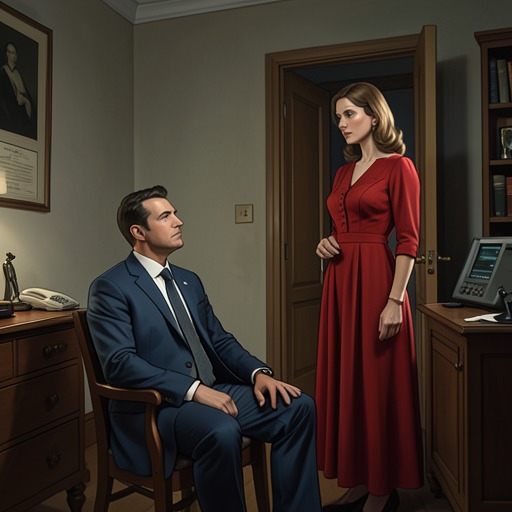
Der goldene HandschuhDesire-Driven Fantasy and Self-Deception is a recurring pattern in which longing supplies its own supposed proof: Fiete Honka interprets Helga Denningsen’s kindness and confidence as signs that she wants him, while WH 3 later mistakes friendship with Petra for romantic possibility. Their fantasies do not merely misread other people; they shape what each man does when reality resists the story he has invented.
Fiete’s Projection onto Helga
Fiete’s hopes gather around ordinary signs of warmth and trust. When Helga laughs at him in a tight-fitting suit, he imagines that she has dressed to please him—not because it is his birthday, but because she likes him as a man. He treats her glances during games of dice as further evidence, even when her unemployed husband, Erich Denningsen, is sitting beside her. In Fiete’s private account, Erich’s repeated emphasis that his unemployment is temporary, his history of broken legs, and his uneven walk all become reasons that he does not deserve Helga. Fiete turns contempt for his rival into imagined proof of his own claim, persuading himself that Helga is already about to choose him.
That interpretation hardens when Helga drinks with him alone and speaks about the life she had hoped for. She regrets that she spends her days cleaning offices and worries that her small wages, together with Erich’s unemployment benefit, will not pay off their house. Fiete cannot tell whether she wants advice or simply someone to listen. But he makes her confidence serve his own desire: he fixates on her body, believes that trust will make physical intimacy follow naturally, and takes their shared silence and further drinks as encouragement. Her disclosure is real; the romantic meaning he assigns to it is his invention.
Helga’s questions about how Fiete came to Hamburg prompt him to tell her about fleeing East Germany in 1951, aged sixteen, and ending up on Bauer Frerk’s farm in Billwerder. There he found agricultural work, but Bauer Frerk beat him day after day with fists, clubs, and a manure fork. After two months Fiete escaped on the farmer’s old bicycle. Being asked about this past matters to him: it has been a long time since anyone showed such personal interest. Yet even this genuine exchange does not correct his assumptions about Helga. He folds the attention she gives his story into the same imagined courtship, as though being heard and being desired were interchangeable.
When Erich leaves to fetch food, Fiete treats his absence as a sudden, perhaps final opportunity. He imagines that Helga’s mention of a visit from her sister, who is often alone after separating from her husband, is a coded announcement that Helga too intends to leave Erich and be with him. He waits, drinks another glass, and counts to sixty, turning the delay into a test that he has devised for himself. At its end, he tells Helga that he loves her and demands sex. He tears at her blouse; she cries out in fear and pain, strikes him, and escapes. The scene makes the consequence of his self-deception plain: he has recast her trust and ordinary conversation as consent, then acts on that fantasy as if it were a fact. Too drunk to follow her, he locks the door and drinks more, fearing that she will go to the police and that he will lose his job or be imprisoned.
WH 3’s Romantic Misreadings
WH 3 repeats Fiete’s mistake in a different register: where Fiete converts Helga’s confidence into an imagined promise, WH 3 turns conversational technique into a fantasy of intimacy. While trying to separate Anita from her friends, he buys her soft drinks, listens attentively, and draws her into talking about herself. When she says she disliked the Bavarian décor and brass band at the Zillertal, he decides that she has no sense of humor. He treats this judgment not as a reason to let the conversation end, but as a problem to solve with a new tactic: he tells her she is unhappy. Anita is startled, then becomes absorbed in analyzing her past and the circumstances of her life. WH 3 takes her willingness to talk as evidence that his maneuver has worked, imagining himself in the role of a psychoanalyst while largely remaining silent.
The scene’s half-hour of conversation does not become the connection WH 3 expects. When he places his hand on Anita’s, she immediately withdraws it and calls him a sad, sad man before returning to her friends. He feels seen by the remark, though he does not accept its judgment of him. Her rejection exposes the gap between his practiced performance of attention and any mutual understanding: he has learned how to prompt disclosure, but mistakes disclosure for desire.
With Petra, the misreading has had longer to grow. After a year of friendship, WH 3 has convinced himself that she may be a romantic possibility, while Petra has understood their relationship as friendship and has repeatedly found ways to avoid his searching hands and rising physical agitation. She recalls that he seemed excessively cool when she greeted him affectionately, a performance she now recognizes as an effort to conceal feelings he could not openly admit. Her retrospective anger is directed at her own mistaken confidence that he wanted nothing beyond friendship, but she also finds his devotion intrusive and needy. For Petra, his love is not a flattering revelation; it is an unwelcome claim on a freedom she wants to retain.
At the Zum Goldenen Handschuh, WH 3 tells himself to abandon the pursuit of desires that cannot be fulfilled. He imagines a quieter future in his comfortable bungalow, taking over the gardening, going on excursions and bicycle rides, and perhaps someday finding reciprocated love. His resolution coincides with Petra’s presence in the bar, but neither recognizes the other’s state of mind. Petra has left him behind in a filthy toilet after concluding that their friendship cannot mean what he thought it did; he has not yet learned that she has gone. Their eyes meet across the room: he salutes her, and she salutes him back, each assigning a private meaning to the brief exchange. WH 3 treats the moment as confirmation that someone there is normal, while Petra’s gesture does not undo her decision to leave. After two double Boonekamp, he considers following her, then turns in the opposite direction, acting at last on his resolve to stop chasing the fantasy.
The Pattern of Misrecognition
The two episodes make desire legible not as mutual feeling but as a story one person builds from signs that mean something else. Fiete converts Helga’s attention into a promise of intimacy; WH 3 treats the disclosure he has coaxed from Anita as evidence of a connection. In both cases, a woman’s words or gestures are filtered through a wish that has already decided what they must signify. The gap is not subtle to the people on the other side: Helga strikes Fiete and flees, Anita removes her hand, and Petra has repeatedly taken practical steps to avoid WH 3’s searching touch. It is the men who preserve the fantasy by recoding refusal, confidence, or ordinary kindness as temporary obstacles to an expected outcome.
The narrative sharpens that gap by moving between WH 3’s hopes and Petra’s account of what she has been observing. His bodily excitement—the heat of his skin, quickening breath, and pulse in his throat—has registered for her as a warning, prompting her to go for drinks, dance, or leave for the toilet. What he experiences as concealed anticipation is, from her perspective, conduct she has been managing and trying to forestall. Their encounter at the bar brings the mismatch into a single frame: they exchange a friendly salute, but the gesture cannot restore the friendship he imagined or reverse her departure. The repeated pattern is therefore also a contrast between inward certainty and outward evidence: longing generates an interpretation, while the consequences of acting on it expose how little that certainty was shared.
The Future as a New Fantasy
WH 3’s resolve to stop pursuing impossible desires sounds like a turn toward reality, but the future he imagines is already another carefully arranged story. He pictures staying in his comfortable bungalow, taking over the gardening, going on bicycle rides and excursions, and perhaps one day finding a love that is returned. His acceptance of limits thus sits beside a fresh promise of eventual romantic fulfillment: the immediate pursuit is renounced, but desire survives by relocating itself to an imagined later life. Even his two double Boonekamp drinks belong to this scene of self-reassurance, as he recasts the rough bar drink as something suited to the people around him while imagining a life safely apart from them.
The narrative places that private prospect beside WH 3’s physical degradation in the bar toilet. While WH 3 struggles with his soaked trousers in a filthy stall, the brief exchange between Petra and Karl von Lützow takes place upstairs: she leaves, Karl considers following, then turns away, and WH 3 emerges only after both have gone. The collision does not make their situations equivalent, but it gives the theme a material counter-image to WH 3’s imagined future. His inner scripts promise control, composure, and a life still open to fulfillment; the scene’s timing instead leaves him alone, disoriented, and moving through a world he experiences as intolerable. The fantasy offers temporary shelter from that world, yet its repeated failure to match other people’s choices is precisely what makes it self-deception.